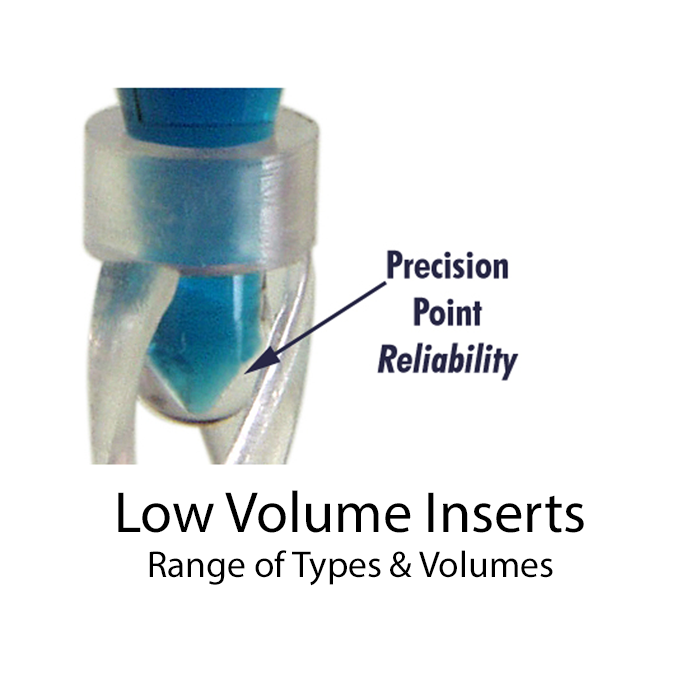
Low‑volume inserts are designed to improve sample recovery and injection accuracy when working with limited sample volumes in chromatography workflows. This subcategory includes vial inserts used in HPLC, LC‑MS, and trace analysis applications, where minimizing residual volume, evaporation, and analyte loss is critical.
Low‑volume inserts allow small liquid samples to be positioned closer to the autosampler needle, helping ensure consistent sample pickup and reducing losses caused by vial dead volume or adsorption to glass surfaces. Proper insert selection can significantly improve reproducibility when sample availability is limited or when working with trace‑level analytes.
This category includes a wide range of insert designs and materials, including:
Flat‑bottom borosilicate glass inserts for economical, non‑critical applications
Precision mandrel‑point inserts designed to center the sample consistently in the vial
RSA™ glass inserts manufactured to reduce surface activity and improve recovery
RSA‑Pro X™ surface‑treated inserts optimized for proteins, peptides, and other glass‑sensitive compounds, available within the U‑2D™ micro‑sample management system
When selecting a low‑volume insert, key factors include vial compatibility, proper insert centering relative to injector specifications, material composition, and the consistency of internal dimensions from lot to lot. These parameters directly affect injection reproducibility and analytical performance.
Low‑volume inserts are offered across multiple performance tiers to support different analytical needs:
BASIK™ brand inserts, intended for economical, non‑critical use
AQ™ brand inserts, offering excellent dimensional control for improved reproducibility
MICROSOLV™ brand inserts, produced from pharmaceutical‑grade glass with precise dimensional design
Additional resources:
Explore the U‑2D™ micro‑sample management system for racked low‑volume inserts
Learn more about U‑2D™ RSA‑Pro X™ surface‑treated inserts for bioanalytical applications