
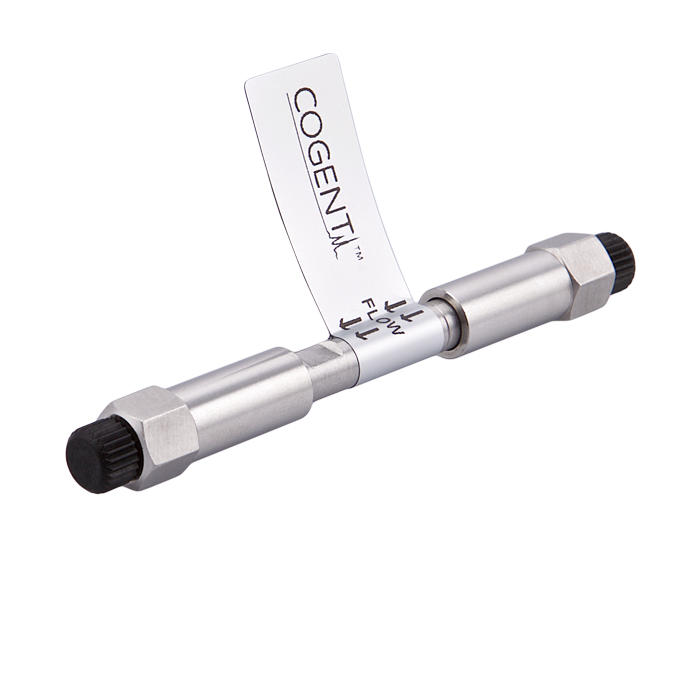
HPLC Column, Amide 2.o, 2.2 um, 2.1 mm ID x 50 mm Length, 120 A. Cogent TYPE-C Brand. 1 EA.
Additional Information:
Advanced Amide HILIC Column for High-Efficiency Separations
The 40236-05P-2 Amide HPLC Column is manufactured using Cogent TYPE-C™ silica hydride technology, providing excellent selectivity, rapid equilibration, and long column lifetime for demanding HILIC applications. The amide stationary phase offers strong and reproducible retention of highly polar analytes while the silica hydride surface helps minimize water-layer instability often associated with conventional silica-based HILIC columns.
Designed for modern analytical workflows, this column combines the retention advantages of amide chemistry with the efficiency of 2.2 µm particles, making it well suited for laboratories requiring fast analyses, high sensitivity, and reproducible performance.
Application Focus: Amide Chemistry for HILIC Separations
Amide stationary phases are particularly useful for the analysis of highly polar compounds and analytes containing hydroxyl or amine functionality. This column is especially effective for:
Sugars and carbohydrates
Sugar alcohols
Amino-containing compounds
Polar metabolites
Polar pharmaceutical compounds
Other HILIC-compatible analytes
The TYPE-C™ silica hydride backbone supports excellent retention reproducibility and improved method robustness compared with many conventional bonded-silica amide phases.
Key Advantages of Cogent TYPE-C™ Amide Technology
Compared to traditional HILIC amide columns, this stationary phase offers:
Faster equilibration between injections
Stable retention across varying mobile-phase compositions
Excellent reproducibility in routine analyses
Robust column lifetime under high-organic HILIC conditions
Reduced water-layer variability due to silica hydride surface chemistry
These characteristics make the Amide phase suitable for both routine analytical testing and HILIC method development.
Why Choose the 2.1 mm × 50 mm Format
The 2.1 mm ID × 50 mm column configuration is optimized for speed and LC-MS performance:
Fast analysis times
High sample throughput
Reduced solvent consumption
Rapid column re-equilibration
Excellent compatibility with LC-MS and LC-MS/MS systems
The narrow internal diameter supports improved MS sensitivity while minimizing solvent load to the detector. This format requires an HPLC system capable of stable low-flow operation.
Particle Size and Performance
The 2.2 µm particle size delivers high chromatographic efficiency and increased resolving power compared to larger particle columns. Analysts can achieve sharper peaks, improved sensitivity, and faster separations while maintaining practical operating pressures on appropriately configured HPLC and UHPLC systems.
System Requirements and Flow Rates
Typical flow-rate range (2.1 mm ID): approximately 0.2-0.3 mL/min
Requires accurate and stable low-flow solvent delivery
Ideal for LC-MS and UHPLC-oriented methods
Not all standard HPLC systems are capable of delivering highly reproducible performance at these reduced flow rates
Actual operating conditions should be optimized according to mobile-phase viscosity, column temperature, sample matrix, and system pressure limitations.