
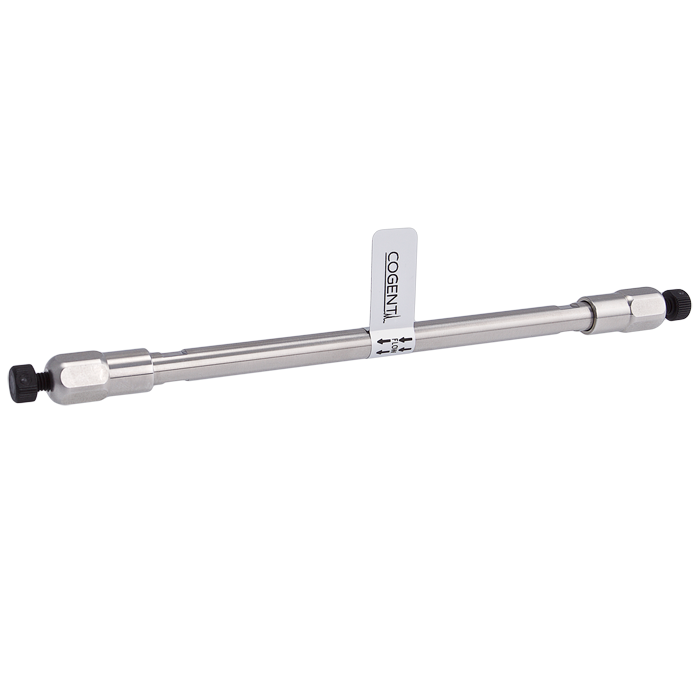
HPLC Column, RP C18, Wide Pore, 5um, 4.6mm ID x 150mm Length, 300A. Cogent Brand. 1 EA.
Additional Information:
The 68518‑15P‑3M Cogent RP C18 Wide Pore HPLC Column is designed for maximum‑resolution separations of large molecular weight analytes, combining 5 µm particles with a 300 Å wide‑pore structure to deliver improved analyte access, peak shape, and reproducibility.
Manufactured using high‑purity silica with traditional octadecylsilane (C18) bonding and fully double end‑capped, this stationary phase provides:
Reduced silanol interactions
Improved peak shape for proteins, peptides, and large polar analytes
Consistent and reproducible chromatographic performance
The 300 Å pore size allows macromolecules to fully access the stationary phase, eliminating restricted diffusion and poor recovery seen with standard 100 Å columns.
150 mm Length – Maximum Resolution & Peak Capacity
Highest resolving power in the 4.6 mm wide‑pore C18 range
Maximizes peak capacity for complex biomolecule mixtures
Ideal for proteins, peptides, and polysaccharides
Preferred for analytical workflows requiring high purity separations
Longer run times compared to 50 mm and 100 mm formats
This configuration is used when maximum separation performance outweighs speed.
4.6 mm ID – Standard Analytical Performance
Industry‑standard HPLC column dimension
Compatible with conventional analytical systems
Typical flow rate range: ~0.8–1.5 mL/min
Optimal starting range: ~1.0–1.2 mL/min
Provides:
Strong detector response
Reliable reproducibility
Easy method transfer across systems
Flow Rate & System Considerations (4.6 mm ID, 5 µm, 300 Å)
Suitable for standard HPLC systems
Supports higher flow rates compared to smaller particle sizes
Well suited for:
Viscous mobile phases
Extended gradients
Routine and complex analytical workflows
Why Choose Wide Pore (300 Å) C18
Designed for Large Molecules
Enables efficient separation of:
Proteins
Peptides
Polysaccharides
Eliminates mass transfer limitations of 100 Å stationary phases
Improved Recovery & Peak Shape
Better analyte penetration into the stationary phase
Improved peak symmetry and reproducibility
Maintains Reversed‑Phase Selectivity
Retains classic C18 hydrophobic interaction behavior
Suitable for lipids and long‑chain fatty acids
RP C18 (5 µm) Performance Advantages
Robust & Reliable Operation
Ideal for routine analytical workflows and method development
Lower backpressure relative to smaller particle sizes
Suitable for long method lifetimes and reproducible results
Reliable Hydrophobic Retention
Strong retention for hydrophobic and neutral compounds
Effective for lipids, fatty acids, proteins, and peptides
Provides greater retention than C8 phases
Method Development Versatility
Ideal for new method development and optimization
Suitable for USP L1 wide‑pore applications
Flexible across diverse analyte classes
Cogent RP C18™ Advantages
Fully End‑Capped Surface
Minimizes secondary interactions
Improves peak symmetry
Better performance for polar and basic analytes
High Purity Silica
Consistent chromatographic results
Reduced variability between runs
Durable & Cost‑Efficient
Long column lifetime
Reduced system strain
Lower maintenance frequency
Typical Applications
Protein and peptide separations
Polysaccharide analysis
Biomolecule HPLC workflows
LC‑MS with flow splitting
Lipids and hydrophobic compounds
Complex mixtures requiring maximum resolution
Important Usage Notes
Designed for large molecule separations using 300 Å pore media
Compatible with standard HPLC systems
Often used with UV detection or LC‑MS with flow splitting
Ideal for applications requiring high‑resolution biomolecule separations