
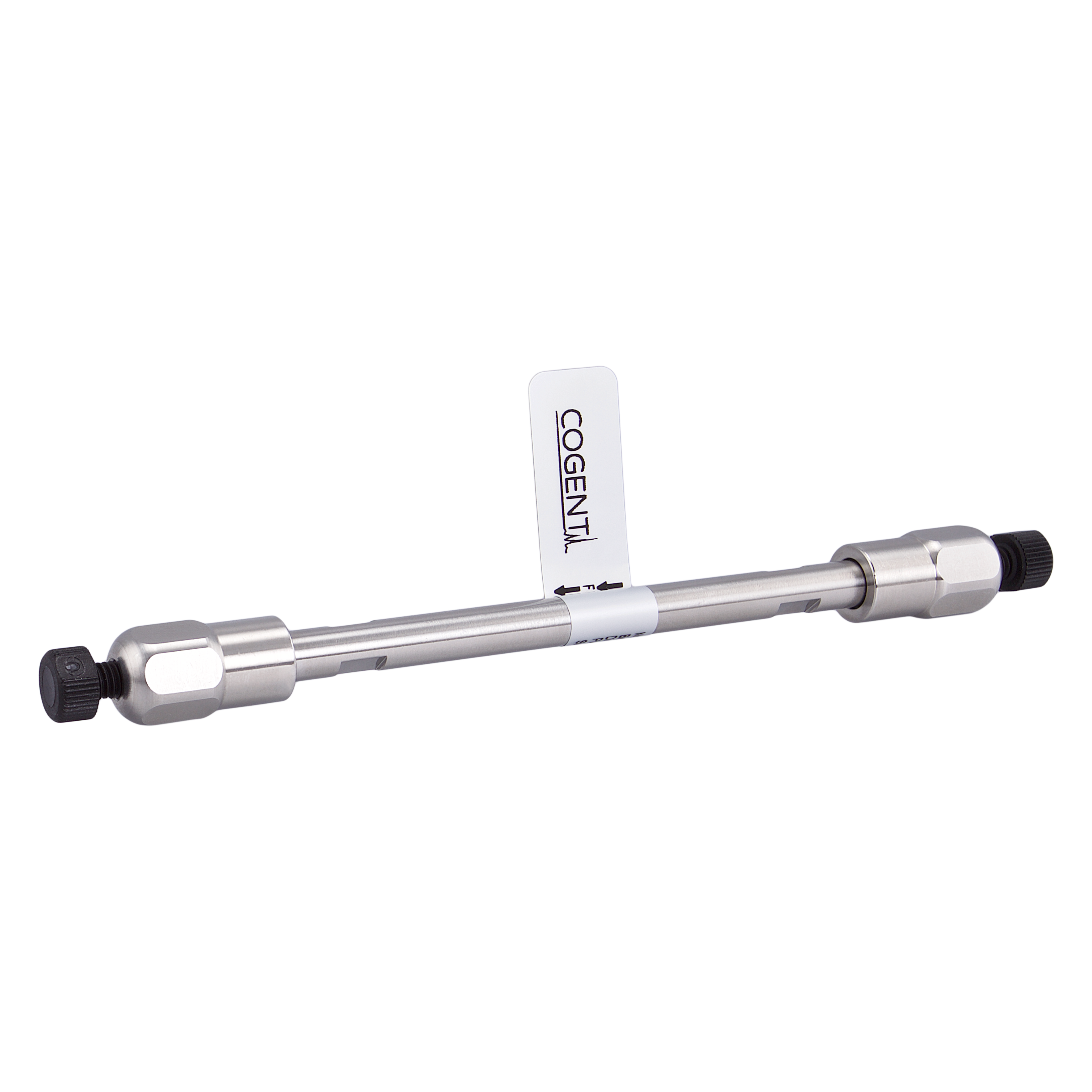
UHPLC Column, RP C8 Octyl, 1.8um, 100A. 2.1mm ID x 100mm Length. Cogent Brand. 1 EA.
Additional Information:
Cogent RP C8 Octyl is a highly versatile reversed-phase HPLC and UHPLC stationary phase designed for the separation of hydrophobic and neutral compounds. Manufactured using a traditional octyl (C8) bonded phase on ultra-high purity silica and fully double end capped, it provides excellent reproducibility, strong hydrophobic retention, and outstanding peak shape. Compared to C4 phases, C8 offers increased retention while often providing faster method development and shorter analysis times than more retentive C18 phases.
68108-10P-2 is a UHPLC column packed with 1.8 µm RP C8 Octyl particles featuring a 100 Å pore size in a 2.1 mm ID x 100 mm format. This is one of the most popular UHPLC column dimensions for modern analytical laboratories due to its balance of high efficiency, low solvent consumption, and excellent compatibility with LC-MS instrumentation. The 100 mm column length provides increased resolution and peak capacity compared to shorter 50 mm formats, while the 1.8 µm particle technology delivers exceptional chromatographic efficiency. This column is specifically engineered for high-pressure UHPLC applications and is designed to take full advantage of UHPLC instrumentation capable of operating at the elevated pressures generated by sub-2 µm particles. Typical operating flow rates are approximately 0.2–0.4 mL/min. Because of the low flow rates required by 2.1 mm ID columns, any HPLC system used with this column must be capable of delivering accurate and reproducible low-flow performance.
This column is ideal for hydrophobic and neutral compounds when reducing analysis time while maintaining resolution, or when improving the resolution of existing methods. The 2.1 mm ID format is widely used for LC-MS applications because of its lower solvent consumption and improved compatibility with mass spectrometry. While compatible HPLC systems may be used in some circumstances, this column is purpose-built for UHPLC operation where the full benefits of sub-2 µm particle technology—including higher efficiency, increased peak capacity, faster separations, and improved resolution—can be achieved.
Key Benefits
RP C8 Octyl stationary phase
Fully double end capped
Traditional octyl (C8) bonded phase
Ultra-high purity silica support
Purpose-built for UHPLC applications
1.8 µm particle technology
Exceptional column efficiency
Increased peak capacity
Improved chromatographic resolution
Reduced solvent consumption
Typical Applications
UHPLC analysis
High-pressure liquid chromatography
LC-MS methods
High-resolution separations
Method development
Hydrophobic compound analysis
Neutral compound analysis
Pharmaceutical analysis
Environmental testing
Impurity profiling
Specifications
Product Type: UHPLC Column
Stationary Phase: RP C8 Octyl
Chromatography Mode: Reversed Phase
Bonded Phase: Octyl (C8)
Endcapping: Fully Double End Capped
Particle Size: 1.8 µm
Pore Size: 100 Å
Column Dimensions: 2.1 mm ID x 100 mm
Length: 100 mm
Typical Flow Rate: 0.2–0.4 mL/min
Brand: Cogent
Important Notes
Specifically designed for UHPLC operation and high-pressure reversed-phase separations
Delivers maximum performance when used on a UHPLC system designed for sub-2 µm particle columns
May be used on compatible HPLC systems only if instrument pressure limits are not exceeded and low-flow operation is reliable
Sub-2 µm particles generate significantly higher backpressure than conventional HPLC columns
This is one of the most popular UHPLC column dimensions and is commonly used for LC-MS applications
The 2.1 mm ID format minimizes solvent consumption while maximizing detector sensitivity
Standard HPLC systems must be capable of precise and reproducible operation at approximately 0.2–0.4 mL/min
The 100 mm length is often selected when greater resolution is required than can be achieved with a 50 mm column
Samples should be filtered through a 0.2 µm syringe filter prior to injection
Provides greater retention than C4 phases while often offering faster method development than C18 columns